


Are you unsure how to adapt and include online trading in your business? While the “digital shift” is well-established, many traditional UK businesses still rely primarily on physical “brick and mortar” storefronts.
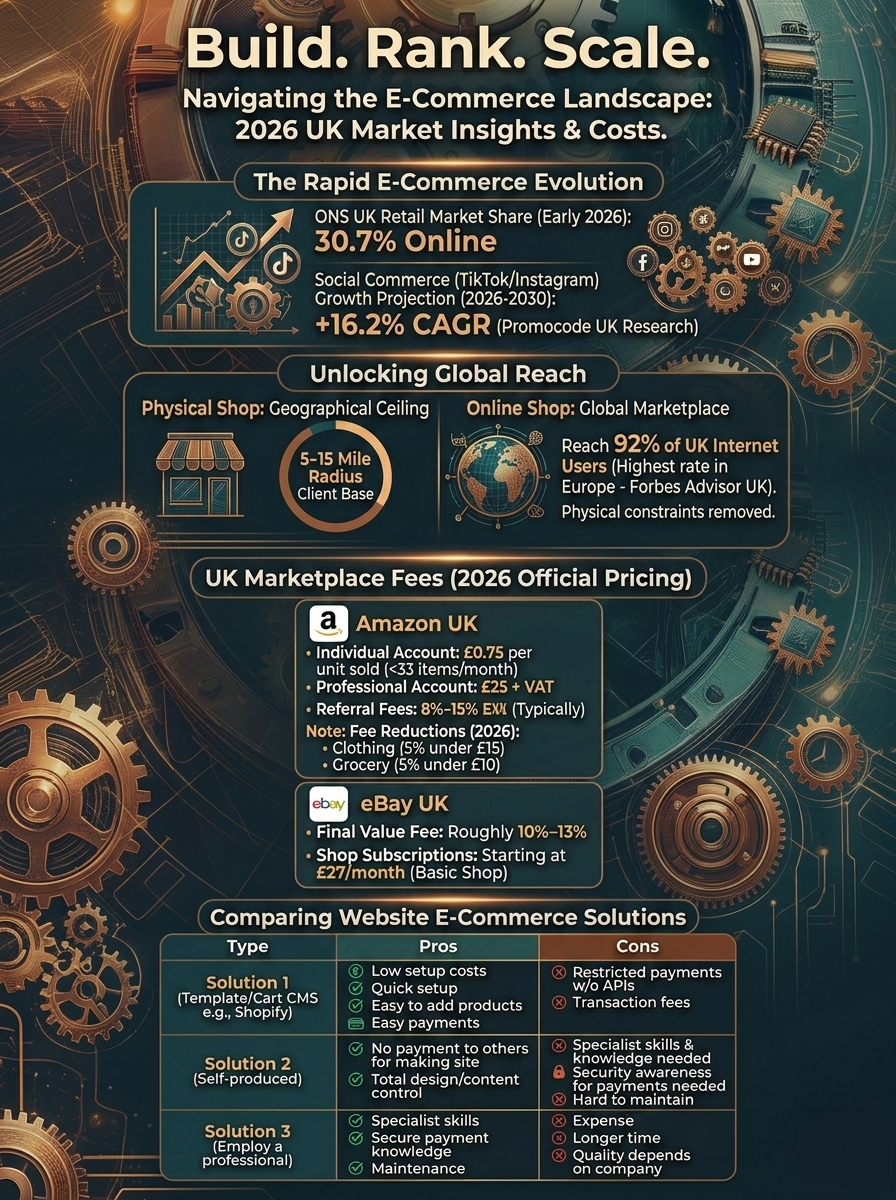
However, the landscape has evolved significantly. According to the Office for National Statistics (ONS), online shopping now accounts for 30.7% of the total UK retail market as of early 2026.
Projections suggest that “social commerce” (selling directly via TikTok/Instagram) will grow by 16.2% CAGR through 2030 (Promocode UK Research).
Planning how to incorporate online trading to become a brick and click organisation is extremely important.
This isn’t as hard as it seems, topics you must cover are:
- Is there a demand?
- How are you going to sell online?
- How can I market my online business?
- How can I fulfil online orders?
- How can I pay for setting up an online business?
Is there a demand?
You need to think about whether there is a demand for your product/service online, often there is!
Selling online removes the “geographical ceiling.”
- Physical Shop: Your client base is restricted to those willing to travel. For most independent shops, this is a 5–15 mile radius.
- Online Shop: You can reach a global marketplace. Physical location, parking, and local travel links no longer dictate your footfall. 92% of UK internet users now shop online—the highest rate in Europe (Forbes Advisor UK).
When selling via a physical shop alone, your client base is restricted to those that are willing to travel to your location.
On average, depending on your industry this can be a 5-15 miles radius [source]. With majority of 3+ miles trips being taken by car, the location of your store, travel links and parking can have a huge impact on footfall.
Online businesses in general, can avoid these issues, as the physical location will not impact on the number of visitors to your website.
Many businesses can tap into new markets and increase demand for their products by trading online, if there is limited need for what they are offering in their local area.
For example, Seasonal traders: Snowsports retailers can target northern hemisphere markets during October to March and then southern hemisphere markets June to October. This results in very little downtime.
How to sell your products and services online
The biggest decision to make is where or what platform you are going to use to sell your products and services.
Are you selling through your own website, other retail sites or a combination?
Selling via Marketplaces (Amazon & eBay)
This is the quickest route, leveraging their massive existing traffic.
- Amazon UK (2026 Fees):
- Individual Account: £0.75 per unit sold (Best for <35 items/month).
- Professional Account: £25 + VAT per month (Official Amazon UK Pricing).
- Referral Fees: Typically 8%–15%. Note: 2026 saw fee reductions in Clothing (5% for items under £15) and Grocery (5% for items under £10).
- eBay UK (2026 Fees):
- Final Value Fee: Roughly 10%–13% depending on the category.
- Shop Subscriptions: Starting at £27/month for a Basic Shop (eBay UK Business Fees).
Using existing sites such as Amazon or eBay means you do not have to invest in building and marketing a website.
The benefits of using reseller sites are quite extensive
- Established and well-known brand name
- High level of traffic and returning users
- Easy to list and sell products
- Secure payment methods
However, there are several possible issues, such as;
- High level of competition
- Not suitable for services
- Restrictions on what you can sell
- Fees and costs for each sale can impact on profit margins
Even with the cons of using these types of sites, many businesses opt to start out using this method.
A major influence is that you do not really need specialist knowledge and expertise to get started.
Short term costs are lower, even with having to pay fees on each sale, than investing in the production and marketing of a new e-commerce website.
However, in the long term, it can be more costly to rely solely on this method as you will be continuously paying fees on each sale.
How to sell on amazon?
There are two main seller types available with Amazon, a basic free account for those who sell less than 35 products per month, which charges £0.75 per sale. As well as a subscription “Pro account” which costs £25 plus VAT a month.
With the Pro account you do not need to pay £0.75 per transaction but are charged a percentage fee based on the product type.
Amazon have included a handy fee calculator to help you work out how much you will be charged per sale.
How to sell on eBay?
There are two main ways to sell on eBay, using a personal account or a business account. It is very likely that you will need to set up as a business seller for your new e-commerce endeavour.
When using a business seller account, you can set up a shop for a fee, see the table below for more information.
If you are only listing produces, without your own dedicated shop, then there are no monthly fees and you can list 1,000 products a month for free. Subject to an insertion fee of £0.35p per product (eBay does carry out promotions for free insertion fees from time to time). In addition, you will also be charged a fee of 10% of sale value, up to £250 for all successful sales.
As most buyers will pay using PayPal, you will also pay 30p per transaction, plus 2.9% of the total sale price.
A good strategy is to use sites such as Amazon and eBay while your own site builds popularity and rises through search engine rankings. You can even invest profits into the production and marketing of your own site.
How can I set up my online business?
When creating a new e-commerce website, there are several things you need to think about. The first is how are you going to create the site. There are several options available to you, each have their own pros and cons.
| Type | Pros | Cons |
| Template/Cart CMS
A readymade e-commerce site such as Shopify or WordPress |
Low set up costs
Quick to set up Easy to add products Easy to accept payments |
Restricted to certain payment methods without external APIs
Fees for transactions |
| Self-produced | You don’t need to pay anyone to make the site
You have control over design and content |
You need specialist skills and knowledge
You need to be aware of security for payments Sites can be hard to maintain |
| Employ a professional | They have the specialist skills required
They are aware of security for payments They can maintain the site for you |
It can be expensive
It may take longer depending on the company’s workload Quality of the site depends on the capability of the development company |
Tips for designing an e-commerce website
- Make sure your homepage is clean and visually appealing
- Create easy to read content
- Make sure your site is easy to navigate
- Make sure your site is mobile friendly
- Use high quality images of your products
- Design the site with your target audience in mind
- Use clear call to action prompts
- Don’t cut corners to speed up the process
How to market your online business? A quick guide
This is a whole topic in its own right! However, a quick overview is;
Social
Create accounts across the most relevant platforms for your target audience, namely
- Snapchat
- YouTube
- Some businesses have started to use TikTok with good results
Make sure your profile is clear on what you do and why your potential customers should use you.
Use quality graphics and pictures.
Include call to action prompts such as “contact us”, “buy now” or “request a quote”.
Add hashtags
Adding hashtags to your posts can increase reach for trending topics. People actively search for hashtag posts online, especially when it comes to twitter.
Monitoring trending hashtags and creating content and posts that are relevant can be a useful strategy. But don’t go overboard with multiple hashtags per post.
Cross promote your media channels
Using your media channels to promote each other is a good strategy to use. For example, advertising your Twitter account on Facebook and vice versa increases awareness of your offerings.
Use social media only discounts
Creating special discounts restricted only to your social media channels can be an effective way to increase followers, likes and shares.
People love finding a good deal and are likely to share with friends and family if they think they would benefit from it.
Alter your approach across platforms
The type of users differs between platforms, so it is a good idea to adjust your content to meet their needs.
LinkedIn for example, is seen as a more professional network than say Instagram, so the content and tone of your posts should be more formal.
Things do change though, and LinkedIn is slowly becoming more of a relaxed platform, which will influence how you advertise and the content you use.
Use a variety of content and be consistent
Using a range of content types is essential. Using a mix of blogs, flyers and videos is the make or break of your marketing campaign.
There has been a huge rise in video marketing across all platforms.
Making sure you post consistently is extremely important. Your audience will come to expect you to post something new. Having a set time and day to post your content is a good idea. What you should be wary of is over posting.
Posting content multiple times on the same platform every single day can reduce the effectiveness of your advertising.
Involve your employees
Your employees are likely to have their own social media accounts. Using them to share and repost your content increases your reach across each platform. Do not make this essential to your strategy though, as your employees may wish to keep their social media life separate from work.
Paid ads
Paid advertising is great way to generate clicks, clicks being visitors to your website. The most common business model is Pay-Per-Click.
As getting to page one on search engine results takes time and a lot of effect, paying for the top(ish) location in search results is a quick and easy(ish) method to get traffic early in the game.
Sound too good to be true? Well the downside is it can be expensive, especially in high competition markets.
You will pay for each click, regardless of whether you make a sale from it, and the cost per click (CPC) can be very high depending on the market and level of competition.
The main types of search ads are text-based ads, followed by display and banner ads.
Text based ads display directly in search results tend to cost more than display ads, which are displayed on websites that are part of the display ad network.
Highly competitive keywords, the search terms your clients will be searching for, can be over £25 per click for search page results.
On average however, most clicks are up to £2 per click.
Display ads are generally lower in cost but have less ROI (return on investment) as people are not actively searching for your products or services when they see your ads.
The most popular platform is Google AdWords as most internet users will search with google, however Bing and Yahoo also run their own paid advertising schemes.
Facebook and LinkedIn also offer paid advertising and tend to be more customisable in terms of targeting specific audiences.
How can I apply SEO to my new site?
SEO is a vast topic that takes a lot of experience and trial and error to get right.
It can be daunting for many people to tackle themselves and can turn into a massive drain on time and money. A lot of companies will outsource SEO to professionals, however there are many actionable tips anyone can apply to their company website.
On page SEO tips
Page titles
- All main page titles must be H1 format, are short and sweet and contain keywords you wish to rank for
- Only have one H1 title per page
- H1 titles must not exceed 70 characters
- Use H2 titles within your page content that contain variations of the keywords you are looking to rank for
Page content
- Use lists (bullet points) for key information to increase likelihood of SERP results
- Do not overstuff keywords, as this will have a negative impact on rankings
- More content and less pages is better than little content on multiple pages
- Your content should be aimed at users and not at search engines
- Use quality images and alt descriptions
- Use videos to increase engagement
For those of you that are more technical minded, you can think about optimising the following
Meta descriptions
- Although meta descriptions do not have much impact on SEO, they do have an impact on click through rates. What can this description say to make a person click on your site over someone else’s?
Page schema
- Think about implementing local business schema on your home page
- Think about adding FAQ schema
- Think about adding Product schema
- You can use this tool to test your schema code
What are the logistics of fulfilling online orders?
Before you have your website or listings up and running, you must think about how you are going to fulfil any orders.
Are you going to include click and collect, local, national or internationals deliveries?
Costing involved has a direct impact on your pricing, especially if you are competing with companies who offer free delivery.
Sending goods via post and courier services is dependent on the size and weight of packages.
There are many different delivery options available to you and it will all come down to costing. Here are some links to get you started
Free Delivery
If you are thinking about offering free deliveries, which can be very effective in increasing sales and competing with other companies, you must think about how you are going to absorb the cost.
Some options are;
- Paying the delivery costs out of profits made elsewhere. If you use this method, you must be careful that you still have adequate cash flow.
- Increasing the prices of your products to ensure you still make a profit
- Increasing the prices your products by a percentage so you share the cost of delivery with your customers
- Local deliveries can be carried out by yourself or your employees. This can reduce costs overall, if you have the required equipment such as cars, vans and enough staff to carry out the deliveries.
It is worth calculating the annual costs, demand and profits gained from your online orders to determine which is the better route, in-house or using delivery services such as those outlined above.
International Trading
Things worth considering are:
- Language barriers
- Cultural differences
- Local laws and regulations
- Import/Export taxes
- Local competition